

Stop Parking the Bus
Willpower is not the solution. Changing your environment is.

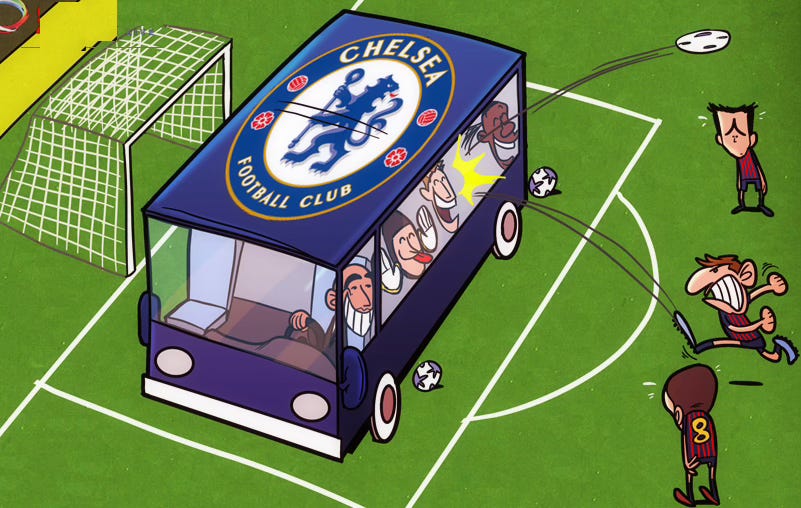
In football (soccer), there are many strategies to win. But the two major directions those strategies are employed are in either attacking or defending.
Some teams play by one philosophy alone, but most teams have many philosophies for different scenarios. For instance, sometimes in a football game, the opposing team might have a lot ball possession and as such will constantly overload your defense, forcing even your attackers to track back to defend as well.
A strategy used to prevent being scored in this scenario is called Parking the Bus.
Basically, most of your players defend the goal, instead of looking for scoring positions themselves. For the opponent facing this strategy, it’s frustrating—like trying to score when there’s a bus parked in front of the post, hence the name.
It’s usually advisable to park the bus only when you have an advantage or lead, or if a goalless end is favorable for you. Because the odds that you will get a goal-scoring chance yourself when you park the bus plummet to near zero.
Stay with me, I promise. This analogy pays off in the end.
Is parking the bus a useful strategy? Yes.
But only when it’s deployed to the highest professional standards. Because the thing with parking the bus is that it relinquishes ball possession for defensive strength. Meaning the coach is basically telling his team, “we don’t care how often the opponent attempts to cross, shoot, or pass their way through our defense. Our job is to quell their attacks. We might not score, and we might not have the ball for most of the game. But we will defend”.
And that—that right there—is the problem with this philosophy.
It requires execution at the highest level of perfection.
Because the more possession the opposition has, the more chances they take, and with every shot blocked, cross intercepted, or shot deflected, the energy of the defensive team dwindles. This strategy requires not just physical conditioning from the defensive team but mental alacrity, positional discipline, and elite reaction time. This is difficult to do for a long period of time. Only a few teams ever successfully deploy this, and—to make it even worse—when they do execute this excellently, all they’ve succeeded in doing is defending their goal, not scoring.
So, Parking the Bus is not very effective for winning competitions that call for endurance, like league games, which requires consistently high performances to amass the most game points over the course of 10 months. It only kind of works when there’s a title on the line (like a cup competition or knockout football, where any losing team is immediately “knocked out” of the competition).
Basically, it’s not a long-term strategy.
It’s for running the final lap.
Parking the bus sounds stressful, right? Why would anybody even want to live like that? Well, that’s what 98% of football fans ask Diego Simeone every single year.
That’s also what I’m asking you today.
Why are you parking the bus?
You’re “parking the bus” anytime you want to quit sodas and snacking at odd hours, but you have a crate of soft drinks in your fridge and a dresser full of Skittles beside your bed.
You’re “parking the bus” when you’re trying to quit drinking but you spend your evenings in the pub with your friends who are drinking and have to walk past the mini bar in the living room on your way to a glass of water.
You’re “parking the bus” when you say you want to watch less tv but don’t have a single recreational object in your vicinity beyond a television.
You get the point.
Why do you constantly put yourself in situations that are optimized for failure? As opposed to cultivating an environment that forces you to make good decisions effortlessly (or with minimal effort)—Optimizing yourself for success.
Why playing life on the defense is dangerous
Do you know the sinister thing about always playing defensively?
When you’re consistently having to make use of all your discipline, willpower, and the highest levels of mental fortitude just to get through the day without making bad decisions, then you’re not going to have much more strength to actually go out and make good decisions.
Because that’s the crazy thing. Good decisions—like scoring a goal—are what “win you games”. Not, not making bad decisions.
If you’re a very observant person, you’ve probably noticed that contrary to what people think, successful people make a ton of bad decisions. In fact, the irony is that when you look at people who aren’t happy with the lives they’ve built for themselves, you don’t see too many bad decisions.
What you see is a few bad decisions that in retrospect feel like TERRIBLE decisions. But they aren’t things that can’t happen to the average person.
They got pregnant at the wrong time. They didn’t take the job. They stayed in a town they weren’t meant to be in a little too long.
Doesn’t look like much, right? Well, that’s because it’s not.
But that’s the problem with defensive strategies. When all your energy is going into not making bad decisions, but you don’t give yourself the opportunity to make a ton of good decisions, you put too much pressure on the few you do make. Every wrong turn shifts the point of failure to a place that is extremely fragile and hard to mitigate.
A clean sheet is great. But to win a game of football, you have to score goals.
You don’t need to go too far into the crevices of your mind to understand what I’m saying here. Just think back on a time you said you would stop (or start) something. Like when you said you’d start exercising by going to the gym, but the closest gym was 11 kilometers away. The amount of good decisions you have to make to get out of bed, go wait for a bus or drive your car, wait for your turn, and motivate yourself through your workout knowing you’ll still have to drive (or walk) all the way home, are staggering. You could make 4 good decisions in a row, and the fifth decision you make (a bad one) turns everything to an unproductive day.
Now, is it true that we are less likely to waste opportunities that cost us more to get (think the team that “parks the bus” suddenly getting a counter-attacking chance out of nowhere and rallying themselves to make a goal from it)?
Yes.
But it’s also true that when you make it easier on your mind to make good decisions, life becomes much easier to live. Also, not everything is about optimizing for stress-to-success ratio. It’s about the quality of life. Being under pressure all the time is not healthy. Does it help you grow? Sure.
But there’s a reason you don’t spend 20 hours in the gym every day. It’s because most high-intensity activities that help you grow still require moderation, else they could have diminishing returns and even become harmful.
So what am I leaving you with?
The caveat of parking the bus is why it’s often heard in football that “attack is the best form of defense”. Outscoring your opposition—meaning, giving yourself more opportunities to attack—is far more effective as a long-term strategy than trying to avoid getting scored. It’s also much more fun for you, the fans, the bank…everybody wins. Creativity finds expression, there are more registered successes that build confidence even when a goal is conceded (because you believe your teammates have the ability to respond with a goal themselves) as opposed to crashing confidence when you try to defend all game and still lose because you conceded a lucky deflected strike in the 91st minute.
It’s a privilege to cultivate an environment that helps you make good decisions. Not everybody gets that chance.
But that privilege is the bedrock of working societies—they make it easy to do the right thing, not hard. In fact, they make it hard to do the wrong thing, which is why their crime has to be so organized. Because most people lack the agency to willfully break laws that are difficult to break. But that’s a yapping for another day.
Today’s lesson:
Give yourself the environment to make good decisions.
At the end of the day, we are the product of a thousand and one environmental influences.
So why not stay ahead of the game and optimize your environment for success?
Thank you so much, Wisdom